
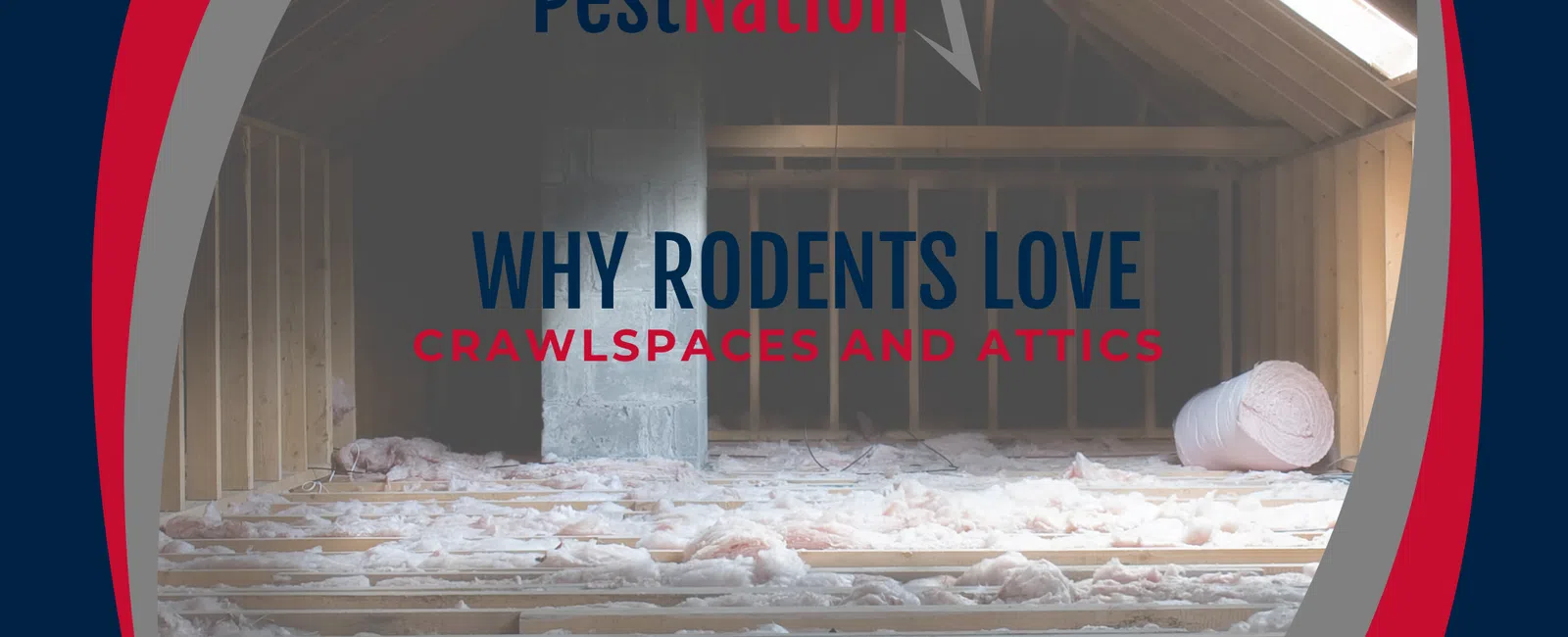
Crawlspaces and attics can provide many of the conditions rodents look for when seeking shelter: protection from weather, limited human activity, concealed nesting areas, and pathways into other portions of a building. Finding rodents in crawlspace areas or evidence in an attic does not necessarily mean the entire home is infested, but these spaces deserve attention because rodents can remain relatively undisturbed there.
Not every attic or crawlspace will develop a rodent problem simply because it is dark or rarely visited. Rodents still need a way to reach the space, and food, shelter, environmental conditions, and species behavior can all influence where activity occurs. Effective prevention and attic rodent control therefore begin with understanding how rodents entered, what resources are available, and whether they have pathways to other parts of the structure.
Why Crawlspaces and Attics Can Appeal to Rodents
Rodents generally seek environments that provide protection and access to necessary resources. Crawlspaces and attics may offer shelter from rain, temperature extremes, predators, and frequent human disturbance.
These areas may also contain materials suitable for nesting, including:
- Insulation
- Paper
- Cardboard
- Fabric
- Stored materials
- Other soft or shredded materials
The presence of these materials does not automatically mean rodents will move in. An accessible entry point is still required.
Once rodents gain access, however, an undisturbed attic or crawlspace may provide a protected location for nesting or harborage.
Rodent Species Do Not All Use Buildings the Same Way
Accurate identification matters because mice, roof rats, and Norway rats differ in their typical behavior.
The UC IPM - Rats describes important behavioral differences between roof rats and Norway rats. Roof rats are skilled climbers and are frequently associated with elevated areas, while Norway rats are commonly associated with ground-level activity and burrowing. These tendencies help professionals determine which travel routes and entry areas deserve attention during an inspection.
Neither species is restricted to only one portion of a property. A roof rat may travel at ground level, and a Norway rat may enter a building when suitable access exists.
House mice are also capable of entering attics, crawlspaces, garages, wall voids, storage areas, and other protected spaces. The species involved should therefore be identified from evidence rather than assumed based only on location.
How Roof Rats May Reach an Attic
Roof rats are particularly relevant when rodent evidence appears in upper portions of a home.
Their climbing ability allows them to use elevated features such as:
- Tree branches
- Fence tops
- Vines
- Utility lines
- Rooflines
- Exterior walls
- Connected structures
These features may function as travel routes between landscaping, neighboring properties, food sources, and buildings.
A roof rat reaching the exterior of a home does not automatically mean it can enter. The animal still needs an accessible structural opening.
Homeowners should never interfere with or attempt to treat electrical or utility lines themselves. When elevated travel routes are suspected, attention should instead focus on vegetation management, structural inspection, monitoring, and appropriate professional evaluation.
Attic Entry Points Can Be Easy to Overlook
Attic access may occur through openings that are difficult to see from ground level.
Potential entry areas include:
- Roof gaps
- Damaged soffits
- Deteriorated fascia
- Attic vents
- Openings around utility penetrations
- Damaged exterior components
Rodents can use relatively small structural openings depending on the species.
That is why attic rodent control should include an evaluation of the building envelope rather than focusing only on the location where droppings or noises were noticed.
An attic may simply be the destination. The actual access point could be somewhere else along the roofline.
How Rodents Enter Crawlspaces
When homeowners discover rodents in crawlspace areas, entry may be associated with lower portions of the structure.
Potential access areas include:
- Foundation openings
- Damaged crawlspace vents
- Utility penetrations
- Gaps around pipes
- Crawlspace doors
- Deteriorated exterior materials
Rodents traveling along foundations, landscaping, or other ground-level features may encounter these openings.
Once inside, crawlspaces can provide sheltered travel routes beneath the home.
Rodents may also find insulation, stored materials, moisture, or pathways into wall voids and utility openings.
CDC Guidance Emphasizes Whole-Home Inspection
The CDC - Seal Up to Prevent Rodents recommends checking potential entry areas around the home, including attic and crawlspace vents, roof areas, utility penetrations, foundations, windows, and doors. This guidance helps explain why rodent prevention should include a thorough review of the home's exterior rather than focusing only on the location where evidence is discovered.
A homeowner who finds droppings in an attic, for example, should not assume the access point is directly above those droppings. Rodents may travel considerable distances within or around a structure.
Likewise, evidence in a crawlspace may originate from an opening on another side of the building.
Understanding the route requires inspection.
Food May Be Somewhere Else on the Property
Rodents do not necessarily use an attic or crawlspace as both their shelter and feeding area.
A rodent may nest in one location and travel elsewhere for food.
Potential food sources include:
- Pet food
- Bird seed
- Garbage
- Pantry products
- Fallen fruit
- Nuts
- Outdoor feeding areas
- Food spills
This means rodents in crawlspace areas may be supported by conditions elsewhere on the property.
A roof rat sheltering in an attic, for example, might travel outdoors to feed and then return through the same structural opening.
Effective management therefore considers the entire property rather than treating the attic or crawlspace as an isolated environment.
Moisture Can Contribute to Favorable Conditions
Water and moisture can also influence pest activity.
Potential sources include:
- Plumbing leaks
- Condensation
- Poor exterior drainage
- Damp crawlspaces
- Standing water
Moisture does not automatically cause rodent activity, but it can contribute to an environment that supports rodents and other pests.
A plumbing leak inside a crawlspace may also damage building materials, making maintenance and inspection more complicated.
Addressing unnecessary moisture is therefore useful as part of a broader pest-prevention strategy.
Rodents May Move Beyond the Attic or Crawlspace
Once rodents enter a structure, existing openings may allow movement into other areas.
Possible pathways can connect attics or crawlspaces with:
- Wall voids
- Garages
- Storage areas
- Utility spaces
- Kitchens
- Other interior rooms
This does not mean a rodent in an attic will inevitably spread throughout the home.
Movement depends on structural pathways, available resources, and species behavior.
However, understanding these connections helps explain why attic rodent control should consider the building as a system rather than treating one room or space in isolation.
Signs of Rodent Activity
Rodents can remain concealed, so homeowners may notice evidence before seeing the animal itself.
Common signs include:
- Droppings
- Gnaw marks
- Nesting materials
- Disturbed insulation
- Damaged stored belongings
- Scratching or movement sounds
- Rub marks
- Repeated sightings
Droppings and other evidence can help professionals determine where rodents are traveling or sheltering.
Their location, quantity, distribution, and relationship to other signs may provide clues about the extent of activity.
Attic Sounds Do Not Always Mean Rodents
Hearing movement above a ceiling can be concerning, but sound alone does not confirm rodent activity.
Attic or crawlspace noises can potentially come from:
- Wildlife
- Plumbing
- HVAC systems
- Expanding or contracting building materials
- Other mechanical or structural sources
This is why inspection is more reliable than assumptions based only on noise.
If scratching or movement sounds occur repeatedly, especially when accompanied by droppings, gnawing, disturbed insulation, or other evidence, a professional pest inspection may help identify the source.
Homeowners should not enter unsafe, contaminated, structurally hazardous, or confined areas simply to investigate a sound.
Droppings Should Be Evaluated Carefully
Rodent droppings can provide useful information, but identification should be approached carefully.
Mouse and rat droppings can differ in size and appearance, and other pests or wildlife may leave evidence that can be misidentified.
Rodent waste also requires appropriate cleanup precautions.
The CDC - Rodent Control provides guidance on preventing rodent exposure and reducing access to food, water, shelter, and buildings. Homeowners who discover droppings or nesting material should follow current public-health guidance for safe cleanup rather than disturbing contaminated material without appropriate precautions.
Professional inspection can help determine whether evidence appears consistent with mice, rats, or another pest.
Nesting Materials Can Reveal Hidden Harborage
Rodents may gather or disturb materials to create protected nesting areas.
Potential nesting materials include:
- Insulation
- Paper
- Cardboard
- Fabric
- Soft stored materials
Disturbed attic insulation can sometimes provide a clue, particularly when combined with droppings, gnawing, or other rodent evidence.
Crawlspaces may contain different nesting opportunities, including insulation, debris, or stored materials.
Finding nesting material does not by itself determine whether activity is currently active. Monitoring and additional evidence may be needed.
Exclusion Is Central to Long-Term Rodent Management
Removing rodents without addressing entry points may allow activity to return.
Pest Exclusion focuses on identifying and correcting structural openings that rodents can use.
For attic activity, that may mean evaluating rooflines, soffits, fascia, vents, and utility penetrations.
For crawlspace activity, inspection may focus more heavily on foundations, crawlspace doors, vents, pipes, and lower-level penetrations.
Exclusion should be based on inspection findings rather than assuming every opening presents the same risk.
Sealing Openings Requires the Right Timing
Finding a structural opening does not always mean it should immediately be sealed without further evaluation.
If rodents are currently inside the building, closing an active entry point without considering their presence may trap animals within the structure or cause them to seek alternative routes.
Professional inspection can help determine:
- Whether activity appears current
- Which species is present
- How rodents may be entering
- Whether multiple entry points exist
- Where nesting or harborage may be located
This information can help guide an appropriate sequence of control and exclusion.
Sanitation and Food Reduction Support Control
Effective rodent management should also reduce the resources that encourage animals to remain around the property.
That may include improving management of:
- Pet food
- Bird seed
- Garbage
- Pantry products
- Fallen fruit
- Outdoor feeding areas
Garages and storage areas should also be evaluated because they may contain both food and shelter.
Sanitation alone may not resolve established rodent activity, but it removes resources that can support continued activity.
Vegetation and Exterior Maintenance Matter
Exterior conditions can influence how rodents approach a building.
Dense vegetation, vines, branches, fences, clutter, and stored materials may provide shelter or travel routes.
For roof rats in particular, tree branches and connected vegetation may provide elevated access toward roofs.
Exterior maintenance can reduce some of these connections and make inspection easier.
However, trimming one branch or removing one pathway does not guarantee that rodents will disappear. Alternative routes or established harborage may remain.
Monitoring Helps Identify Recurring Activity
After cleanup, control, or exclusion work, continued monitoring can help determine whether activity has declined.
Homeowners may watch for new:
- Droppings
- Gnaw marks
- Nesting material
- Disturbed insulation
- Sounds
- Sightings
Recurring evidence may suggest that rodents remain inside or that an entry point has not been identified.
The UC IPM - Pest Notes: Rats discusses rat biology and management practices including sanitation, exclusion, habitat modification, and monitoring. This supports a broader strategy in which rodent management addresses both the animals and the conditions allowing activity to continue.
Attic Rodent Control Requires a Broader Strategy
Effective attic rodent control is not limited to addressing a rodent that happens to be visible.
A comprehensive approach may combine:
- Species identification
- Exterior inspection
- Entry-point evaluation
- Food-source reduction
- Sanitation
- Vegetation management
- Monitoring
- Exclusion
- Appropriate professional control
The same principles apply to rodents in crawlspace environments.
Integrated Pest Management works by combining several appropriate measures based on the pest species and property conditions rather than relying on one universal solution.
When Professional Inspection May Be Appropriate
Attics and crawlspaces can be difficult or unsafe for homeowners to inspect.
Professional evaluation may be appropriate when there are:
- Recurring droppings
- Repeated scratching sounds
- Gnaw marks
- Nesting materials
- Disturbed insulation
- Multiple sightings
- Evidence in inaccessible areas
PestNation Pest Inspections can help identify the species involved, likely travel routes, structural entry points, nesting areas, and conducive conditions.
Professional Rodent Control can then be coordinated with Pest Exclusion and other preventive measures when appropriate.
Crawlspace and Attic Rodents Across the Southeast
Homes in different Southeastern markets can present different rodent-access conditions.
For homeowners seeking Atlanta Pest Control or Charlotte Pest Control, crawlspaces, mature trees, wooded neighborhoods, garages, and attic spaces may all be relevant during an inspection.
For Orlando Pest Control, warm conditions can support outdoor rodent activity throughout much of the year, making vegetation, rooflines, exterior storage, and food sources important considerations.
For Charleston Pest Control, crawlspace conditions, dense landscaping, moisture, roof access, and exterior openings may all warrant attention depending on the property.
When activity is confirmed, PestNation's Residential Pest Control, Rodent Control, Pest Exclusion, and appropriate Interior and Exterior Pest Treatments can be selected according to inspection findings rather than assumptions about where rodents should be located.
Finding rodents in crawlspace areas or signs of activity in an attic can indicate that the structure is providing shelter, but the location alone does not explain the entire problem. Rodents still require access, and their movement may be influenced by food sources, structural openings, vegetation, moisture, nesting materials, and species-specific behavior.
Roof rats, Norway rats, and mice may use buildings differently, which makes accurate identification valuable. Roof rats are particularly capable climbers, while Norway rats are more commonly associated with ground-level activity and burrowing. Mice can also exploit openings leading to attics, crawlspaces, garages, and wall voids. These tendencies can help guide inspection without assuming that any species is restricted to one location.
Effective attic rodent control and crawlspace rodent management should therefore address more than the animal itself. Inspection, exclusion, food-source reduction, sanitation, exterior maintenance, vegetation management, monitoring, and appropriate professional control can work together to reduce recurring activity. Structural openings should also be addressed carefully so rodents are not inadvertently trapped inside.
When droppings, gnaw marks, disturbed insulation, nesting material, repeated sounds, or other evidence continues, PestNation Pest Inspections can help determine where rodents are entering and what conditions are supporting them. A property-specific approach combining Rodent Control, Pest Exclusion, and preventive maintenance can address both current activity and the pathways that may allow rodents to return.