
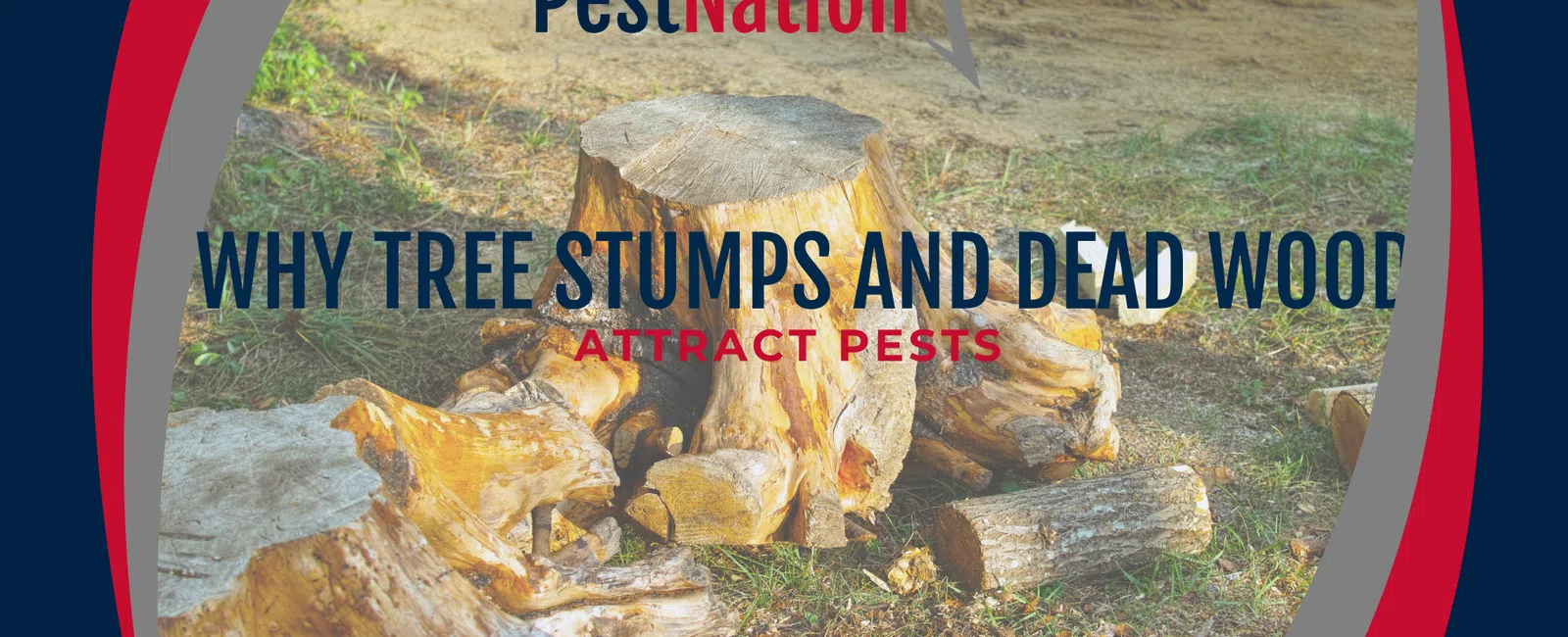
Tree stumps, fallen branches, old logs, firewood, buried roots, and other dead or deteriorating wood are common around residential properties. In many cases, they are simply part of the landscape and do not create an immediate pest threat. As wood begins to decay, however, it can retain moisture, soften, develop protected spaces, and become easier for certain insects and other organisms to use for food, shelter, or nesting. These conditions can make decaying wood worth monitoring, particularly when it is located close to a home.
Understanding tree stump pests is primarily an exterior pest-prevention and property-maintenance issue. Termites, carpenter ants, wood-boring beetles, and other organisms may naturally occur in dead wood outdoors without indicating that the home itself is infested. The greater concern is whether favorable habitat is developing close to foundations, crawlspaces, decks, porches, or other structural components. Addressing unnecessary wood debris, moisture, drainage, and landscaping conditions can help reduce dead wood pest problems while making it easier to identify signs that deserve professional attention.
Why Dead Wood Can Become Attractive to Pests
Living wood contains moisture and complex structural defenses that change after a tree dies. Once wood begins deteriorating, fungi, moisture, weather, and other natural processes gradually break it down.
Decaying wood may provide:
- Moisture
- Shelter
- Protected galleries
- Nesting locations
- Food for wood-feeding organisms
Different pests use dead wood for different reasons.
Termites can consume cellulose found in wood. Carpenter ants do not eat wood but may excavate softened or moisture-damaged areas for nesting. Certain beetles develop within wood, while spiders and other insects may simply use cracks and spaces for shelter.
That distinction is important when evaluating tree stump pests.
Tree Stumps Can Retain Moisture
One reason old stumps become attractive to some insects is their ability to hold moisture.
Rainwater may collect around:
- Root systems
- Bark
- Cracks
- Hollow areas
- Soil surrounding the stump
As decomposition progresses, the interior may remain damp even when the outer surface appears relatively dry.
Moisture can make wood easier for certain insects to colonize while creating a sheltered microenvironment protected from direct sunlight and temperature extremes.
A stump in a shaded, poorly drained area may therefore create different conditions than one located in an exposed, dry part of the property.
Termites Naturally Use Dead Wood
Subterranean termites play an important ecological role by breaking down dead plant material.
Outdoors, colonies may forage through soil and encounter:
- Stumps
- Fallen branches
- Buried roots
- Lumber scraps
- Firewood
- Other cellulose-containing materials
Information from UGA Extension - Subterranean Termites provides useful context about termite biology and the conditions that can support termite activity, helping explain why wood and moisture around a home's exterior deserve attention as part of termite prevention.
Finding termites in a distant stump does not automatically mean the home has an active termite infestation.
However, termite activity close to a structure deserves additional attention because subterranean termites can forage through soil beyond the visible piece of wood where they were first discovered.
Wood-to-Soil Contact Matters
Subterranean termites live in or maintain connections to soil where they obtain moisture.
Wood that directly contacts soil can therefore create favorable access to cellulose.
Examples include:
- Buried lumber
- Old landscape timbers
- Stumps
- Roots
- Wood scraps
- Firewood resting directly on soil
When these materials are located near a foundation or crawlspace, they deserve closer monitoring.
Guidance from NC State Extension - Termite Control provides additional context about termite prevention and conditions around structures, reinforcing why dead wood should be considered as part of a broader exterior pest-management strategy rather than as an automatic indication of structural infestation.
Reducing unnecessary wood-to-soil contact near the home can make the immediate perimeter less favorable for termite activity.
A Termite-Infested Stump Is Not the Same as a Home Infestation
This distinction is important.
A stump can contain termites while the nearby home remains unaffected.
Termites are naturally present in many Southeastern environments, and colonies routinely forage through soil looking for suitable cellulose.
The concern increases when:
- The stump is close to the foundation
- Other wood contacts soil nearby
- Moisture problems exist
- Mud tubes appear on the structure
- Structural wood shows damage
Those conditions warrant closer investigation.
Homeowners should avoid assuming either extreme: termites in a stump do not automatically mean the house is infested, but they also should not be ignored when activity occurs close to structural wood.
Carpenter Ants Use Wood Differently
Carpenter ants are sometimes confused with termites because both can be associated with wood.
The difference is significant.
Carpenter ants do not consume wood as food. Instead, they excavate galleries to create nesting spaces.
They often prefer:
- Moisture-damaged wood
- Decaying wood
- Hollow trees
- Stumps
- Damp structural areas
A deteriorating stump can therefore become a suitable nesting site.
Workers may travel away from that nest while searching for food, which can occasionally bring them toward houses or other structures.
Carpenter Ant Activity Can Point to Moisture
Recurring carpenter ant activity around structural wood may indicate a need to investigate moisture.
Potential sources include:
- Roof leaks
- Plumbing leaks
- Damaged siding
- Poor drainage
- Wet framing
Removing ants without correcting persistent moisture can leave the underlying conducive condition unresolved.
This principle applies outdoors as well.
A damp stump or decaying log may simply provide a suitable nesting site because moisture has already softened the wood.
Wood-Boring Beetles May Use Dead or Seasoned Wood
Many types of beetles are associated with wood, but their biology varies significantly.
Depending on the species, beetles may develop in:
- Recently dead wood
- Seasoned wood
- Bark
- Logs
- Firewood
Some are primarily outdoor insects that rarely become structural pests.
Others may be more important if suitable wood is brought indoors or incorporated into a building.
Small holes, powdery material, galleries, or emerging adult insects may indicate beetle activity, although professional identification may be necessary to determine whether the insect poses a structural concern.
Other Organisms May Occupy Decaying Wood
Dead wood supports an entire ecosystem.
Homeowners may encounter:
- Spiders
- Centipedes
- Millipedes
- Beetles
- Earwigs
- Ants
Many of these organisms are simply using the wood because it provides moisture and shelter.
Information from UGA Extension - Insect and Arthropod Pests of Southeastern Neighborhoods provides useful context about common insects and arthropods found around Southeastern landscapes and homes. This helps explain why a decaying stump may contain numerous organisms without necessarily representing a direct structural pest problem.
The location of the wood matters as much as the organisms living within it.
Dead Wood Near Foundations Deserves More Attention
A decaying log at the back edge of a large property presents a different concern than deteriorating wood directly beside the foundation.
Dead wood near a home may increase pest activity around:
- Foundation walls
- Crawlspace vents
- Exterior doors
- Utility penetrations
Once pests are active near the building envelope, they have more opportunities to encounter structural openings.
This does not mean pests will automatically move indoors.
It simply makes inspection and prevention more important.
Crawlspaces Can Compound Wood and Moisture Conditions
Homes with crawlspaces may have additional pest-conducive conditions if dead wood is nearby.
Crawlspace environments can include:
- Elevated humidity
- Plumbing leaks
- Wood framing
- Ground moisture
- Limited airflow
A stump, buried root system, or wood debris immediately outside the crawlspace can add another potential source of insect activity.
Homeowners should also make sure wood scraps or construction debris were not left beneath the home.
Buried or concealed wood can remain attractive to termites for years.
Decks and Porches Need Similar Attention
Decks and porches contain structural wood that may be relatively close to soil.
When stumps, logs, or old roots remain beneath or beside these structures, pest activity in the dead wood may occur near structural components.
Homeowners should periodically inspect:
- Support posts
- Joists
- Stairs
- Ledger areas
- Wood near soil
Signs of deterioration or insect activity warrant further evaluation.
Fallen Branches and Logs Can Become Long-Term Harborages
Storms and tree trimming often leave branches or logs around a property.
When these materials remain on the ground, decomposition begins naturally.
Over time, they may:
- Retain moisture
- Develop loose bark
- Soften
- Create cavities
These features make them useful habitat for many organisms.
Removing unnecessary wood debris can reduce pest harborage and make landscape maintenance easier.
Buried Roots Can Remain After Stump Removal
Removing the visible stump does not always remove the entire root system.
Large roots may remain underground and continue decaying.
Subterranean termites may still encounter these materials while foraging.
This is one reason stump removal should not be viewed as a guaranteed termite-control method.
The visible wood may disappear while biological activity continues elsewhere underground.
Landscaping Debris Can Add More Wood Sources
Stumps are only one form of cellulose around a home.
Other materials may include:
- Branch piles
- Lumber scraps
- Old fence boards
- Landscape timbers
- Wooden edging
- Construction debris
If these materials remain damp or contact soil, they can become pest-conducive.
Removing unnecessary debris improves both pest prevention and general property maintenance.
Construction Wood Should Not Be Left Buried
Wood scraps left behind after construction or renovation can sometimes become concealed beneath soil, mulch, or crawlspace areas.
Because homeowners may not know the material is present, termite activity can remain hidden.
Buried construction wood can provide cellulose with direct soil contact, which makes it particularly worth addressing when discovered.
A professional inspection can help determine whether nearby termite activity extends beyond the buried material.
Firewood Storage Requires Thoughtful Placement
Firewood naturally contains bark, cracks, and wood fibers that insects may use.
Potential occupants can include:
- Beetles
- Ants
- Spiders
- Termites
This does not mean firewood is inherently hazardous.
The primary prevention issue is storage.
Keeping stored firewood appropriately separated from the home's foundation and avoiding unnecessary long-term wood-to-soil contact can reduce pest activity directly against the structure.
Bringing Firewood Indoors Can Transport Insects
Insects hiding within firewood may occasionally become visible after wood is brought inside.
Indoor warmth can increase activity in organisms that were relatively inactive outdoors.
In many cases, these are temporary hitchhikers rather than established indoor infestations.
Bringing in only the amount of firewood needed for near-term use can reduce the amount of outdoor material stored inside living spaces.
Moisture Management Supports Exterior Pest Prevention
Wood decomposition and pest activity are often influenced by moisture.
Potential moisture sources near dead wood include:
- Poor drainage
- Irrigation
- Downspout discharge
- Standing water
- Dense shade
Improving drainage can reduce prolonged dampness around foundations and wooden materials.
Moisture management also helps protect structural components from deterioration.
For homeowners addressing dead wood pest problems, water management is often just as important as removing the wood itself.
Gutters and Downspouts Can Influence Ground Moisture
Clogged gutters or poorly directed downspouts may saturate soil near a foundation.
If stumps, roots, wood debris, or landscape timbers are present in the same area, moisture can create more favorable conditions for decomposition and pest activity.
Routine gutter maintenance can help direct water away from the building.
This supports both structural maintenance and pest prevention.
Vegetation Maintenance Improves Visibility
Dense vegetation can hide:
- Stumps
- Wood debris
- Mud tubes
- Damaged structural wood
Keeping shrubs and groundcover maintained around the home allows easier visual inspection.
It can also improve airflow and reduce persistent shaded moisture around the foundation.
Landscaping does not need to be eliminated.
The goal is to avoid creating dense, inaccessible areas where pest activity can remain hidden.
Removing a Stump Does Not Automatically Eliminate Pests
A common misconception is that removing a termite- or ant-infested stump automatically solves the pest problem.
That may not be the case.
A termite colony may be located elsewhere in the soil and simply feeding on the stump.
Carpenter ants may have additional nesting sites.
Other insects may already occupy nearby wood.
Stump removal can reduce one favorable habitat, but it should be considered part of a larger prevention strategy rather than a complete treatment.
Look for Signs Around the Home
Routine exterior inspections can help homeowners identify potentially important pest evidence.
Signs worth investigating include:
- Mud tubes
- Damaged wood
- Hollow-sounding wood
- Ant trails
- Insect galleries
- Repeated swarming insects
- Exit holes
Some signs can have causes unrelated to termites or other wood-destroying insects.
Professional identification helps prevent unnecessary assumptions.
Mud Tubes Deserve Prompt Attention
Subterranean termites may construct mud tubes as protected pathways between soil and other locations.
Mud tubes observed on:
- Foundations
- Crawlspace supports
- Masonry
- Structural wood
should be evaluated.
Information from University of Florida IFAS - Termite Prevention and Control provides additional context regarding termite biology, inspection, prevention, and structural considerations. This is particularly relevant in warm regions where termite pressure can be significant and where moisture and wood-to-soil contact deserve ongoing attention.
A professional termite inspection can determine whether the evidence represents current activity and whether structural wood is involved.
Integrated Pest Management Applies Outdoors
Guidance from the U.S. EPA - Introduction to Integrated Pest Management supports an approach that combines identification, monitoring, prevention, habitat modification, and appropriate control methods rather than relying on treatment alone.
For tree stump pests, Integrated Pest Management may involve:
- Removing unnecessary wood debris
- Improving drainage
- Managing vegetation
- Reducing wood-to-soil contact
- Monitoring pest evidence
- Correcting structural openings
- Using professional treatment when appropriate
This broader approach addresses the environment that supports pest activity.
Exterior Monitoring Helps Detect Changes
A stump that shows no visible pest activity today may change as it continues decomposing.
Periodic monitoring can help homeowners notice:
- Increasing insect activity
- Softening wood
- New galleries
- Termites
- Ant colonies
Monitoring is especially valuable when dead wood is located close to a foundation or other structure.
The objective is not constant alarm but routine awareness.
Atlanta Pest Control and Wood-Destroying Insects
For homeowners seeking Atlanta Pest Control, warm temperatures, rainfall, humidity, and wooded landscapes can support significant outdoor insect activity.
Stumps and dead wood near:
- Crawlspaces
- Foundations
- Decks
- Landscaping
should be included in routine exterior inspections.
PestNation Pest Inspections can help determine whether activity is confined to landscape wood or extends toward the structure.
Charlotte Pest Control and Exterior Wood Conditions
Properties needing Charlotte Pest Control may experience termite, ant, beetle, and other insect activity throughout extended warm seasons.
Rainfall and drainage conditions can influence how quickly wood deteriorates.
Homeowners can reduce pest-conducive conditions through moisture management, debris removal, and periodic exterior inspection.
Orlando Pest Control and Year-Round Pest Pressure
For Orlando Pest Control, warm temperatures and high humidity can support decomposition and insect activity throughout much of the year.
Tree roots, stumps, landscape timbers, and wood piles may remain damp for extended periods depending on site conditions.
Consistent monitoring and Residential Pest Control can help homeowners manage pest pressure before activity becomes widespread.
Charleston Pest Control and Moisture Management
For Charleston Pest Control, coastal humidity, rainfall, and shaded landscapes can create conditions where dead wood stays damp.
Homes with crawlspaces may warrant particular attention to wood debris, drainage, and termite evidence around the perimeter.
Routine Termite Inspections and Termite Control can help identify whether exterior termite activity is affecting structural components.
When a Professional Inspection Is Appropriate
Professional inspection may be warranted when homeowners find:
- Active termites near the structure
- Mud tubes
- Structural wood damage
- Carpenter ants repeatedly indoors
- Extensive insect galleries
- Recurring swarms
- Unexplained wood deterioration
PestNation Pest Inspections can help identify the pest involved and determine whether activity is limited to outdoor wood or associated with the structure.
For termite concerns, professional Termite Inspections and Termite Control can provide a more specific evaluation.
How PestNation Addresses Dead Wood Pest Problems
At PestNation, effective Residential Pest Control begins with identifying both the pest and the conditions supporting it.
An exterior inspection may evaluate:
- Tree stumps
- Firewood
- Wood piles
- Crawlspaces
- Foundations
- Moisture
- Drainage
- Structural openings
When treatment is appropriate, Interior and Exterior Pest Treatments may be combined with habitat modification, moisture management, exclusion, and monitoring.
This approach recognizes that removing one stump or treating one visible insect does not necessarily address the complete pest environment.
Tree stumps, fallen branches, old roots, firewood, buried lumber, and other dead wood can provide food, moisture, shelter, or nesting opportunities for certain insects as decomposition progresses. Termites may consume cellulose, carpenter ants may excavate damp or deteriorated wood for nesting, and wood-boring beetles may develop in different types of dead or seasoned wood. At the same time, tree stump pests living outdoors do not automatically indicate that the nearby home has an active infestation.
Reducing dead wood pest problems is best approached through routine property maintenance and Integrated Pest Management. Removing unnecessary wood debris, managing drainage, limiting wood-to-soil contact near structures, maintaining vegetation, storing firewood thoughtfully, and monitoring for pest evidence can all reduce favorable conditions. When homeowners discover termites, mud tubes, recurring carpenter ants, unexplained wood damage, or other significant signs, PestNation Pest Inspections, Termite Inspections and Termite Control, professional Residential Pest Control, and appropriate Interior and Exterior Pest Treatments can help determine whether the issue is limited to outdoor habitat or requires additional action around the home.