
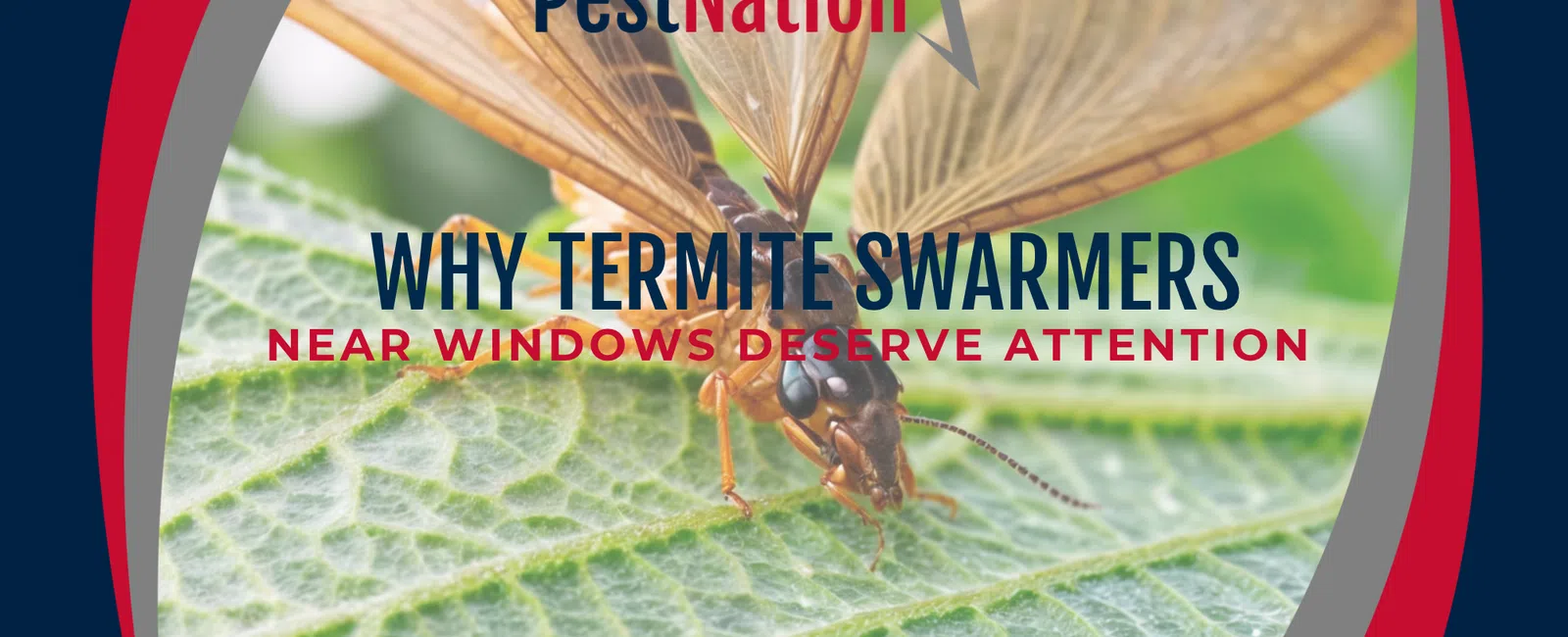
Finding winged insects gathered around a window can raise questions for homeowners, especially when the insects appear suddenly or leave behind small piles of discarded wings. While many flying insects are attracted to light, some of these visitors may be termite swarmers. Their presence can provide an important clue about termite activity, although it does not automatically mean an active termite colony is established inside the home.
Understanding why termite swarmers near windows appear, how to distinguish them from flying ants, and what their presence may indicate can help homeowners respond appropriately. Swarmers may originate from a colony associated with the structure or enter from an outdoor swarm. Because their appearance alone cannot establish the location, size, or activity status of a colony, professional identification and inspection are valuable when evaluating possible termite infestation signs.
What Are Termite Swarmers?
Termite swarmers are winged reproductive termites, also called alates. Unlike worker termites, which perform many of the activities necessary to maintain a colony, swarmers are involved in reproduction and the potential establishment of new colonies.
When conditions are suitable and a colony reaches an appropriate stage of development, it may produce winged reproductive individuals. These termites leave the established colony during a swarming event.
After dispersal, surviving reproductive termites may shed their wings and attempt to establish new colonies under suitable conditions.
However, not every swarmer successfully establishes a colony. Environmental conditions, predators, available shelter, and other factors influence whether reproduction and colony development occur.
The UGA Extension - Subterranean Termites discusses subterranean termite biology, reproductive behavior, and colony development. This information helps explain why winged termites may appear in noticeable numbers during swarming events and why their presence should be evaluated in the context of termite biology.
Swarming patterns vary by species, geographic location, temperature, humidity, rainfall, and other environmental conditions. Not all termite species swarm during the same season or time of day.
Why Termite Swarmers Gather Near Windows
Windows are common locations where homeowners notice winged insects because certain termite swarmers respond to light.
Natural daylight entering through windows can attract or concentrate some swarmers near glass surfaces. Artificial lighting may also influence where certain winged termites gather.
As a result, homeowners may discover insects around:
- Windowsills
- Window frames
- Sliding glass doors
- Glass patio doors
- Interior light fixtures
- Other illuminated areas
A window may become a visible gathering point even when it is not the original location from which the termites emerged.
Some swarmers may enter from outdoors through an open window, door, or another accessible opening. Others may emerge from a colony associated with the building and move toward available light.
This distinction is important because finding insects near a window does not identify the exact location of a termite colony.
Do Termite Swarmers Indoors Mean an Infestation?
Finding termite swarmers inside a home deserves attention, but it does not automatically prove that an active termite colony is established within the structure.
Winged termites can enter from outdoor swarms, particularly when doors or windows are open or other access points are available.
However, swarmers emerging from within a building may indicate termite activity associated with the structure.
The U.S. EPA - Termites: How to Identify and Control Them provides information about termite identification, warning signs, prevention, and management. This guidance supports evaluating winged insects and other evidence rather than assuming that every swarmer sighting confirms an indoor infestation.
The circumstances surrounding the discovery can provide useful information.
For example, a few winged insects found near an open window may require a different evaluation than repeated swarming events occurring inside a closed room.
Neither observation, by itself, establishes the extent of termite activity.
Professional inspection helps place the sighting in context and determine whether additional evidence is present.
Why Discarded Wings May Appear on Windowsills
One of the more recognizable signs associated with termite swarming is the presence of discarded wings.
After dispersal, termite reproductive individuals may shed their wings as part of the process associated with seeking suitable conditions for colony establishment.
These wings can accumulate near windowsills, doorways, light fixtures, and other locations where swarmers have gathered.
Homeowners may notice wings even after the insects themselves are no longer visible.
However, discarded wings do not independently establish the location of a termite colony or whether active termite activity is occurring within the home.
Other insects can also leave behind wings or wing fragments.
A pile of wings should therefore be evaluated alongside insect specimens, the location of the discovery, and other possible termite evidence.
Repeated discoveries of similar wings may provide additional information during a professional inspection.
How to Tell Termite Swarmers From Flying Ants
Termite swarmers are frequently confused with winged ants.
Both insects may appear in groups, fly toward light, and gather around windows or doors. However, several physical characteristics can help distinguish them.
Termite swarmers generally have:
- Relatively straight antennae
- A broad waist without a pronounced constriction
- Two pairs of wings that are approximately equal in length
- A body shape that appears relatively uniform through the middle
Winged ants generally have:
- Elbowed antennae
- A more noticeably constricted waist
- Forewings that are typically larger than their hindwings
- A more clearly segmented body profile
These differences can be useful, but identification is not always straightforward.
Damaged insects, incomplete specimens, or individuals that have already shed their wings may be difficult to identify accurately.
Color and size alone are not reliable indicators, and other winged insects may also appear near windows or lighting.
The NC State Extension - Termite Control provides educational information about termite biology, identification, inspection, and management. Understanding these characteristics helps homeowners recognize why proper identification is necessary before assuming that winged insects are termites.
When uncertainty remains, professional pest identification is preferable to relying solely on appearance or location.
How Weather and Seasonal Conditions Influence Swarming
Termite swarming is influenced by environmental conditions, but there is no single schedule that applies to every termite species.
Temperature, humidity, rainfall, colony development, and other factors may influence when reproductive termites emerge.
Some species swarm during daylight hours, while others may swarm during evening or nighttime conditions.
This means termite swarming should not automatically be described as a nighttime event.
Regional conditions also matter.
Termite activity in Georgia may follow different seasonal patterns than activity in Florida, North Carolina, or South Carolina.
Even within the same state, weather and species differences can influence when swarmers appear.
For homeowners, the practical lesson is that the calendar alone cannot confirm or rule out termite activity.
Winged insects discovered around windows should be identified based on their characteristics and surrounding evidence rather than assumptions about the season.
What Subterranean Termites Have to Do With Window Swarmers
Subterranean termites are an important consideration throughout much of the Southeastern United States.
These termites are generally associated with soil, where colonies obtain moisture and maintain protected environments.
They may access structures through suitable pathways, including foundation-related openings, concealed construction features, or other areas that allow movement between soil and cellulose materials.
When a subterranean termite colony produces reproductive individuals, swarmers may emerge and disperse.
Some may become visible near windows or illuminated interior spaces.
However, finding swarmers near a window does not establish that subterranean termites are entering through that window.
The actual source may be elsewhere, and different termite species have different nesting and swarming behaviors.
A professional termite inspection can help determine whether additional evidence supports the possibility of subterranean termite activity or another termite species.
Other Termite Infestation Signs Worth Evaluating
Swarmers and discarded wings are useful observations, but they are not the only potential indicators of termite activity.
During an inspection, professionals may look for visible evidence such as mud tubes, suspicious wood damage, moisture conditions, and wood-to-soil contact.
Mud tubes are particularly relevant to many subterranean termite situations because they can provide protected pathways between soil-associated colonies and accessible materials.
However, the absence of visible mud tubes does not prove termites are absent.
Termite activity may occur in concealed or inaccessible locations, and not all termite species create the same visible evidence.
Moisture and drainage conditions may also be relevant. Plumbing leaks, persistent dampness, and wood-to-soil contact can contribute to conditions associated with certain termite species.
These conditions do not automatically cause an infestation or establish that termites are present.
A professional evaluates multiple findings rather than relying on one observation.
What Happens During a Professional Termite Inspection?
A professional termite inspection focuses on identifying accessible evidence of termite activity and conditions that may support it.
Depending on the property, the inspection may include accessible foundations, crawlspaces, basements, garages, exterior walls, exposed wood components, and areas around plumbing penetrations.
Inspectors may evaluate suspicious wood conditions, mud tubes, discarded wings, moisture-related concerns, and other visible indicators.
The exact scope depends on accessibility, property construction, and the type of inspection performed.
A PestNation Termite Inspection can help homeowners better understand whether observed swarmers are associated with additional evidence of termite activity.
However, termite inspections have limitations.
Concealed wall systems, finished flooring, insulation, and inaccessible structural components may prevent direct observation of hidden conditions.
Inspectors cannot see through every building material or guarantee detection of every concealed colony or damaged area.
Additionally, the presence of termite swarmers does not establish the extent of structural damage. Suspected structural concerns may require separate evaluation by appropriately qualified construction or structural professionals.
What Homeowners Should Do After Finding Swarmers
When homeowners discover suspected termite swarmers near windows, documenting the observation can help with identification and inspection.
Useful information includes the approximate date and time, the location where insects appeared, whether doors or windows were open, and whether similar activity has occurred previously.
Clear photographs may be helpful.
If practical and safe, collecting a few intact insect specimens can also support identification. Specimens may provide characteristics that are difficult to evaluate from photographs alone.
Homeowners should avoid damaging walls, flooring, trim, or other building materials in an attempt to locate a colony.
Spraying visible swarmers alone does not necessarily address an underlying termite colony.
The most appropriate next step is to identify the insects and evaluate whether additional termite evidence is present.
Why Professional Termite Management Requires More Than Treating Swarmers
Termite management should begin with accurate identification and an understanding of the property's conditions.
The U.S. EPA - Integrated Pest Management Principles emphasizes inspection, monitoring, prevention, and informed pest-management decisions. These principles support evaluating suspected termite activity before determining whether monitoring, preventive improvements, or treatment is appropriate.
For termite concerns, this may involve reviewing moisture conditions, accessible cellulose materials, wood-to-soil contact, previous treatment history, and visible evidence.
A home that has previously received termite treatment should not automatically be considered permanently protected.
Management needs vary according to termite species, property construction, prior treatments, and current inspection findings.
Professional Termite Control recommendations should reflect these factors rather than assuming every swarmer sighting requires the same response.
Termite Swarmer Activity Across the Southeast
PestNation serves Southeastern markets where termite species and seasonal conditions can vary.
In Atlanta Pest Control and Charlotte Pest Control markets, swarming activity may be influenced by local temperature, rainfall, humidity, and species characteristics.
In warmer Orlando Pest Control areas, seasonal patterns may differ from those in more northern locations.
Similarly, Charleston Pest Control markets may experience coastal environmental conditions that influence termite behavior.
These differences make it important to avoid assigning one swarming season to the entire Southeast.
PestNation's Pest Inspections, Termite Inspections, Termite Control, and Residential Pest Control services can help homeowners evaluate suspected termite activity and identify appropriate management considerations.
Professional inspection is especially valuable when swarmers appear repeatedly indoors, discarded wings accumulate, or other possible termite evidence is present.
Why Termite Swarmers Near Windows Should Not Be Ignored
Finding termite swarmers near windows can be an important observation, but it is not a complete diagnosis of termite activity. Winged termites may gather near natural or artificial light, and their presence may reflect an outdoor swarm or activity associated with the structure. Discarded wings can provide additional evidence, although neither insects nor wings alone establish the location, severity, or current status of a termite colony.
Proper identification is the first step toward understanding what has been discovered. Termite swarmers can resemble flying ants and other insects, making professional evaluation valuable when physical characteristics are unclear. Documenting the location, timing, and recurrence of sightings can also help inspectors interpret the evidence.
Professional termite inspection considers the broader property, including accessible foundations, crawlspaces, wood components, moisture conditions, and other potential termite infestation signs. Although an inspection cannot guarantee detection of every concealed condition, it can help determine whether further monitoring, preventive action, or termite management is appropriate.
For homeowners across PestNation's Southeastern service areas, responding to suspected swarmers with accurate identification and informed inspection is more useful than assuming the worst or dismissing the insects entirely. PestNation's termite inspection and management services can help homeowners understand the evidence and determine practical next steps based on the conditions present at their property.